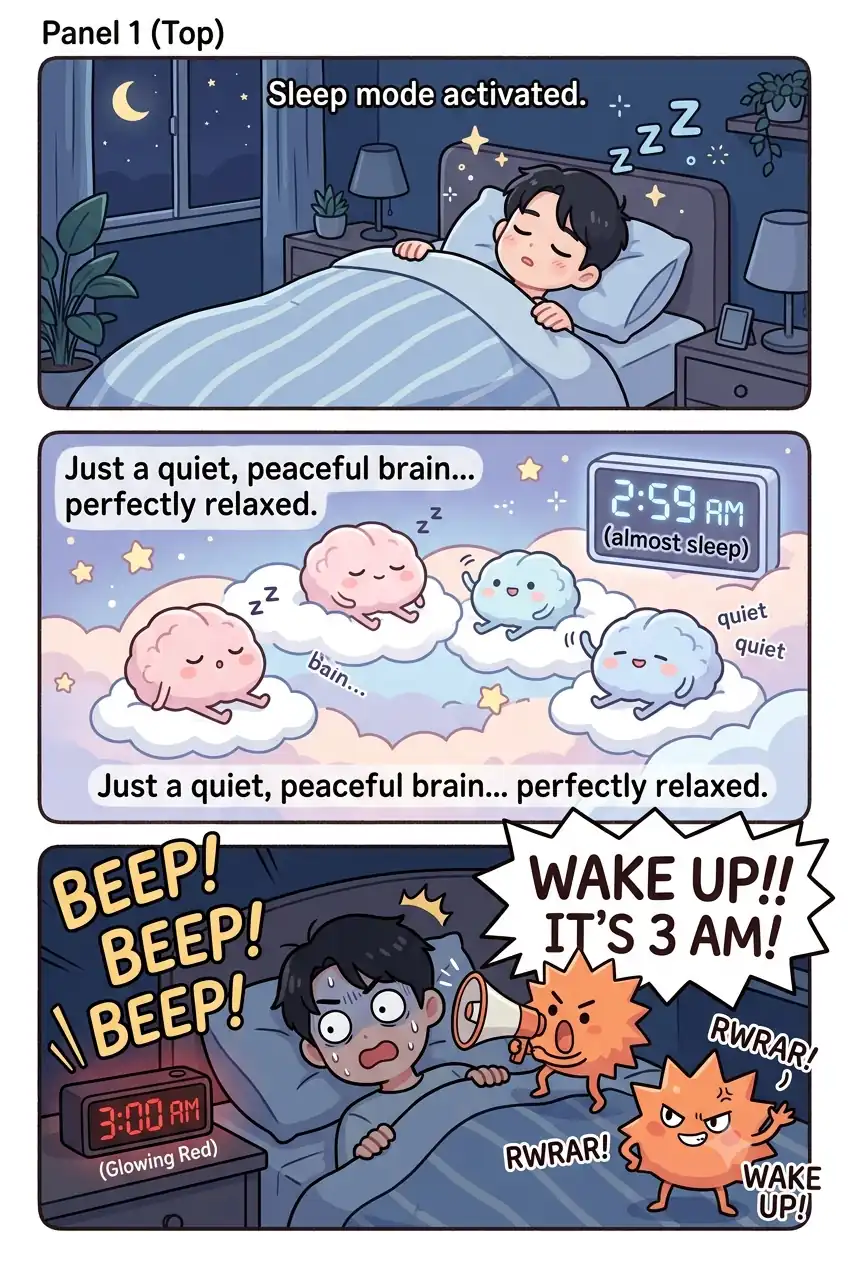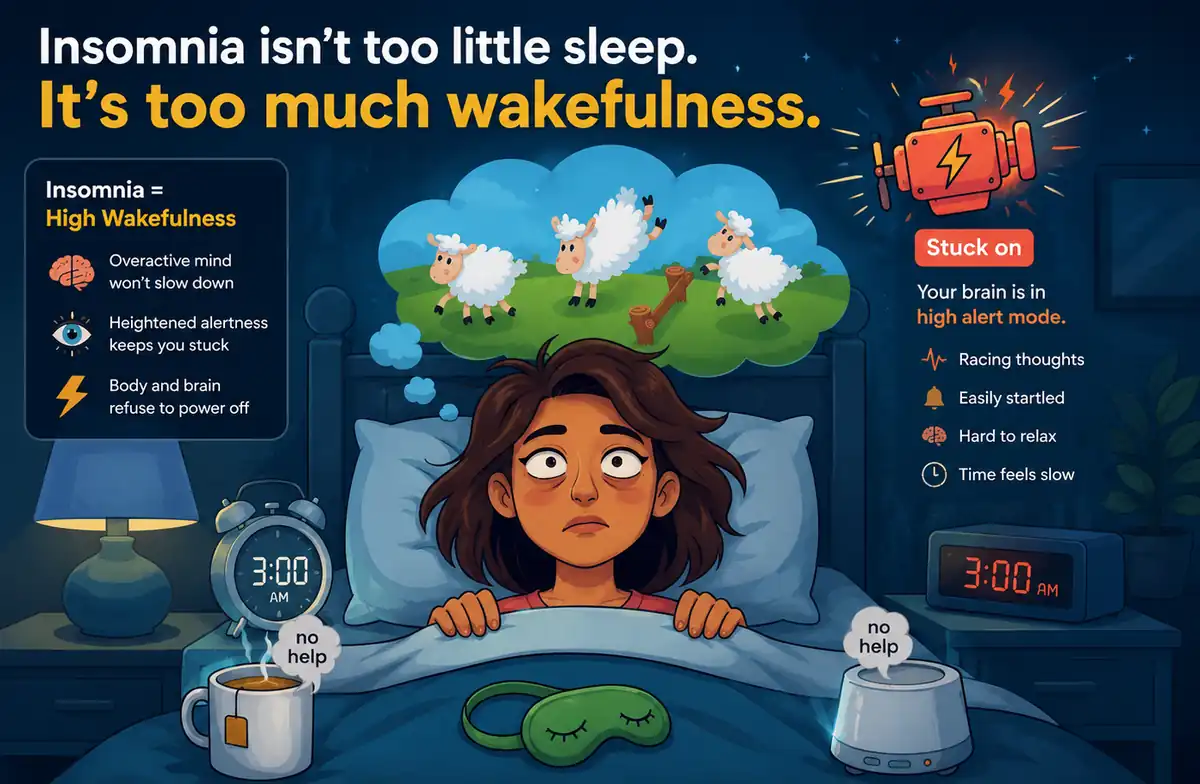








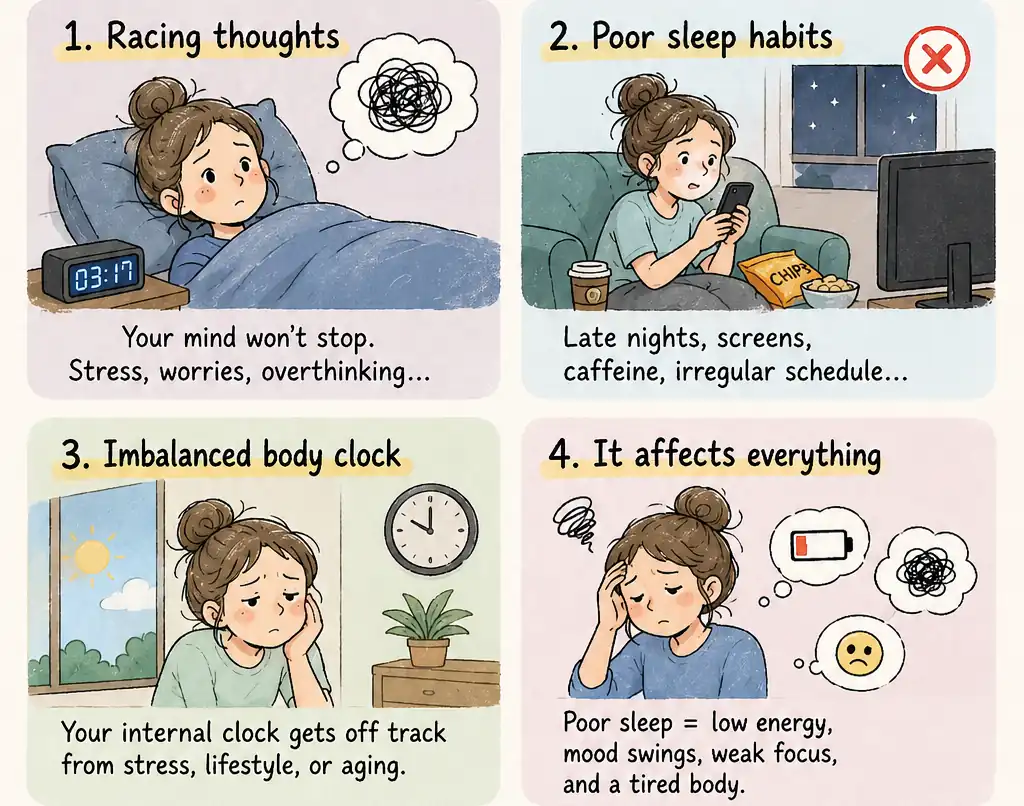
- Falling Asleep vs. Staying Asleep: Drifting off quickly at 11 p.m. doesn’t guarantee quality rest if you keep waking up in the middle of the night.
- The Brain’s 3 A.M. Trap: Nighttime awakenings trigger anxiety and mental math, turning brief wakeups into full-blown mental workouts.
- Balanced Nighttime Support: Rather than forcing sleep with heavy knock-out ingredients, supporting natural relaxation routines often yields better long-term results.
Why Waking Up in the Middle of the Night Feels So Much Worse
It’s 3:07 a.m.
The house is completely quiet. The streets outside are quiet. Everyone else seems to be asleep.
Except you.
And the strange thing is… you wasn’t having trouble falling asleep. You went to bed around 11 p.m. and fell asleep fairly quickly. No tossing and turning. No staring at the ceiling for hours. You were tired, you went to bed, and you slept.
Then, somewhere around 3 a.m., your eyes suddenly opened. You look at the clock. 3:07. And almost immediately, you think: “Oh no. Not again.”
If you’ve ever experienced waking up in the middle of the night, you probably know what happens next. Your body feels exhausted, but your brain? Wide awake.
Suddenly, yesterday’s unfinished email comes to mind. Then tomorrow’s schedule. Then that meeting next week. Then something slightly embarrassing you said three days ago for absolutely no reason. Your brain has apparently decided that 3 a.m. is the perfect time to hold its weekly meeting.
You try not to think about it. Which, of course, makes you think about it even more. You close your eyes, turn over, and try to relax. You tell yourself: “I really need to sleep.”
Thirty minutes pass. Then forty. You look at the clock again. 4:18. Now you’re doing the math: “If I fall asleep right now, I can still get almost two hours…” And somehow that thought makes falling asleep even harder.
Eventually, you drift off again. Then the alarm goes off, and the next day feels like you’re walking around with half your brain switched off. Coffee helps for about twenty minutes, then your heart starts beating faster than your productivity. By the afternoon, you’re staring at your computer screen wondering why a simple task suddenly feels like advanced mathematics.
Why does waking up in the middle of the night feel so much worse?
At first, I assumed the problem was simply stress. So I tried all the usual advice: less coffee, more exercise, no phone before bed, a regular bedtime, a darker bedroom, and a cooler bedroom. I tried to keep everything as “sleep-friendly” as possible.
And yet, waking up in the middle of the night kept happening.

That’s when I started wondering if I had been looking at the problem from the wrong direction. Maybe the issue wasn’t falling asleep—I could fall asleep fine. The real problem was staying asleep. And those are two very different things.
You can fall asleep quickly at 11 p.m. and still find yourself waking up in the middle of the night several hours later feeling completely awake. Once you’re awake, the problem can become even bigger because you start worrying about being awake:
- “Why am I awake?”
- “What time is it?”
- “How long have I been lying here?”
- “How am I going to function tomorrow?”
And suddenly, a brief nighttime awakening has turned into a full mental workout.
Maybe Sleep Isn’t Something You Can Simply Force
For a long time, I thought the answer was to find something strong enough to make me sleepy. The stronger, the better. But the more I thought about it, the less that made sense.
Sleep isn’t really an on/off switch. You can’t always tell your brain: “Okay. Shut down now.” Especially when your mind is still processing everything that happened during the day—stress, work, family, deadlines, and random thoughts that somehow become incredibly important at 3 a.m.
So instead of trying to force sleep, I started looking at a different idea: What if the goal was to support the conditions that make sleep easier?
That means looking at the whole nighttime routine rather than relying on one single ingredient or one single trick:
- A consistent bedtime.
- Less stimulation before bed.
- A comfortable sleeping environment.
- A calmer mind.
- And potentially, some additional sleep support.
A Different Approach to Nighttime Sleep Support
This is what made me curious about Yu Sleep. Instead of focusing on just one thing, Yu Sleep takes a combination approach, bringing together ingredients intended to support different aspects of nighttime rest and relaxation.
The idea is fairly simple. Rather than trying to push one ingredient as hard as possible, why not use several complementary ingredients in a thoughtful formula? Something to help provide a nighttime signal, something to support relaxation, and something to help with the mental wind-down that can be so difficult when your mind refuses to slow down.

Together, those elements may provide a more balanced form of natural sleep support. That’s very different from expecting a supplement to simply “knock you out.” And honestly, that’s what I was looking for. I wasn’t looking for something that would make me unconscious. I wanted something that could fit into a normal nighttime routine and support better sleep without making the whole experience feel like a battle.
Ready for a More Balanced Nighttime Rest?
Discover how a thoughtful combination of ingredients can support your natural sleep routine.
What Happens When You Stop Fighting the Night?
One night, I experienced waking up in the middle of the night again. Same story. Same quiet room. Same familiar feeling that I was about to spend the next hour staring at the ceiling.
I reached for my phone. Then stopped. I didn’t check the time. I didn’t start calculating how many hours were left until morning. I didn’t start reviewing tomorrow’s schedule.
I simply closed my eyes again: “Okay. I’m awake. That’s fine.”
And surprisingly… I fell back asleep.
Maybe it was the routine. Maybe my mind was simply calmer. Maybe the combination of better habits and sleep support helped. Probably some combination of everything. But something important had changed: I wasn’t fighting sleep anymore.
You Don’t Have to Sleep Perfectly
That’s probably the biggest lesson. Waking up in the middle of the night doesn’t necessarily mean you’ve failed at sleeping. People wake up. Stress happens. Travel happens. Late dinners happen. Life happens.
The goal isn’t necessarily to become someone who never wakes up during the night. It’s being able to settle back down when you do.
That’s why I became more interested in a balanced approach to sleep rather than simply searching for the strongest possible sleep supplement. The basics still matter:
- A consistent schedule matters.
- Your nighttime environment matters.
- Your stress levels matter.
And for some people, adding a thoughtfully formulated sleep supplement may be another piece of the puzzle. Yu Sleep fits into that kind of approach—not as a magic button, nor as a promise that you’ll never wake up again, but as a way to support your nighttime routine with a combination of ingredients designed around sleep and relaxation.
Take the Pressure Off Your Sleep Routine
See how Yu Sleep approaches nighttime support without heavy promises or harsh knockouts.
And If You’re Reading This at 3 a.m…
If you’re experiencing waking up in the middle of the night right now, take a breath. You’re not the only one. And you don’t necessarily have to turn that moment into a battle.
Quick Reminders for 3 A.M.:
- Don’t stare at the clock.
- Don’t calculate how many hours of sleep you have left.
- Don’t convince yourself that tomorrow is already ruined.
Try closing your eyes again. Let your body settle. Give your mind a chance to slow down. And remember that waking up doesn’t mean the night is over.
Sometimes, the hardest part isn’t falling asleep again. It’s simply stopping yourself from trying so hard to fall asleep.
The next time you find yourself waking up in the middle of the night, you might try a different approach. Instead of asking “Why can’t I sleep?”, try asking: “What can I do to make this moment more comfortable?”
Sometimes a better night’s sleep starts there. And if you’re looking for additional sleep support, a balanced approach like Yu Sleep may be worth exploring alongside healthy sleep habits. Because you don’t need to “win” against sleep. You just need to give your body and mind a better chance to let it happen.
🌐 Reference Sites & Medical Authorities: